
POWSAF interviews Dr. Rod King, Inventor of the Fractal Grid Technology (FGT); Part 2 – The application and use of FGT for the Prince of Wales School
Recent News & Articles
Tribute to SHA Sawyerr, Former Principal of the Prince of Wales School
POWSAF interviews Dr. Rod King, Inventor of the Fractal Grid Technology (FGT); Part 3 – The application and use of FGT for Sierra Leone
POWSAF interviews Dr. Rod King, Inventor of the Fractal Grid Technology (FGT); Part 1 – Dr. King and the Prince of Wales School
The Emergence of The Prince of Wales School
The First Girls at The Prince of Wales Secondary School
The Prince of Wales School Teaching Staff, 1968
The Prince of Wales School Football Team, National Champions—1951
HRH The Prince of Wales Visit, 6th April 1925
Tribute to Archimedes Faulkner, Founding Trustee of POWSAF

POWSAF interviews Dr. Rod King, inventor of the Fractal Grid Technology (FGT), in a three-part series. Dr. King, thank you for taking the time to answer POWSAF’s questions in your busy schedule. We have prepared nine (9) questions on various topics, especially about the Prince of Wales School, your alma mater. This interview will be published in three parts, each covering three questions:
Part 1 – Dr. King and the Prince of Wales School; Part 2 – The application and use of FGT for the Prince of Wales School; and Part 3 – The application and use of FGT for Sierra Leone.
Part 2– The application and use of FGT for the Prince of Wales School
POWSAF: You invented the Fractal Grid Technology (FGT). What is the Fractal Grid technology, and why did you see the need to develop it? Can you provide an example(s) of POWSAF using your invention?
Dr. Rod King: In brief, the Fractal Grid Technology (FGT) refers to an innovative process and collaboration platform for visually storing, collecting, organizing, presenting, and evaluating a mountain of information in a brain-friendly manner while using a 3×3 Fractal Grid (Table) that usually looks like a Tic-Tac-Toe board; the center of a Fractal Grid is highlighted and reserved for inputting the main topic, heading, or title of a presentation. The Fractal Grid Technology aims to rapidly solve the global problem of information overload, complexity, inaccessibility while facilitating creativity, hyperlearning, innovation, and productivity not only for individuals but also for teams and organizations everywhere.
The FGT saves individuals and organizations lots of time, energy, and money especially in creative problem solving, business model innovation, and project management. Interestingly, I did not deliberately seek to develop the Fractal Grid Technology. Rather, it was an “unsolicited idea” that literally came out of the blue and struck me on the road in 2004 while I was driving and after dropping off my daughter, Ecy, in Kindergarten. Ecy is now a Junior (Third Year) student at Stanford University. So, I’d say that FGT has been around a while. The Fractal Grid Technology as well as my name as the inventor is currently cited in 30 US Patents including the patents of the world’s most innovative companies, e.g., Apple; Google; Microsoft; IBM; Samsung; Adobe; Oracle; GE. Over the years, I’ve moved from positioning the Fractal Grid Technology as a 3×3 Fractal Grid organizer and visual search engine to presenting it as a Fractal Grid Methodology that focuses on the process of Universal Visual Communication, Problem Solving, System Thinking, and Business Model Innovation, notwithstanding Fractal Grid Sketchnoting.
Although the Fractal Grid Technology and in particular, the Fractal Grid tool is used around the world for visually organizing and presenting information, nothing gives me greater pleasure than in seeing Princewaleans use the Fractal Grid. Recently, I was delighted to see POWSAF use a Fractal Grid to present info relating to the “What, Why, and Where” of POWSAF. What greater recognition could I ask for?
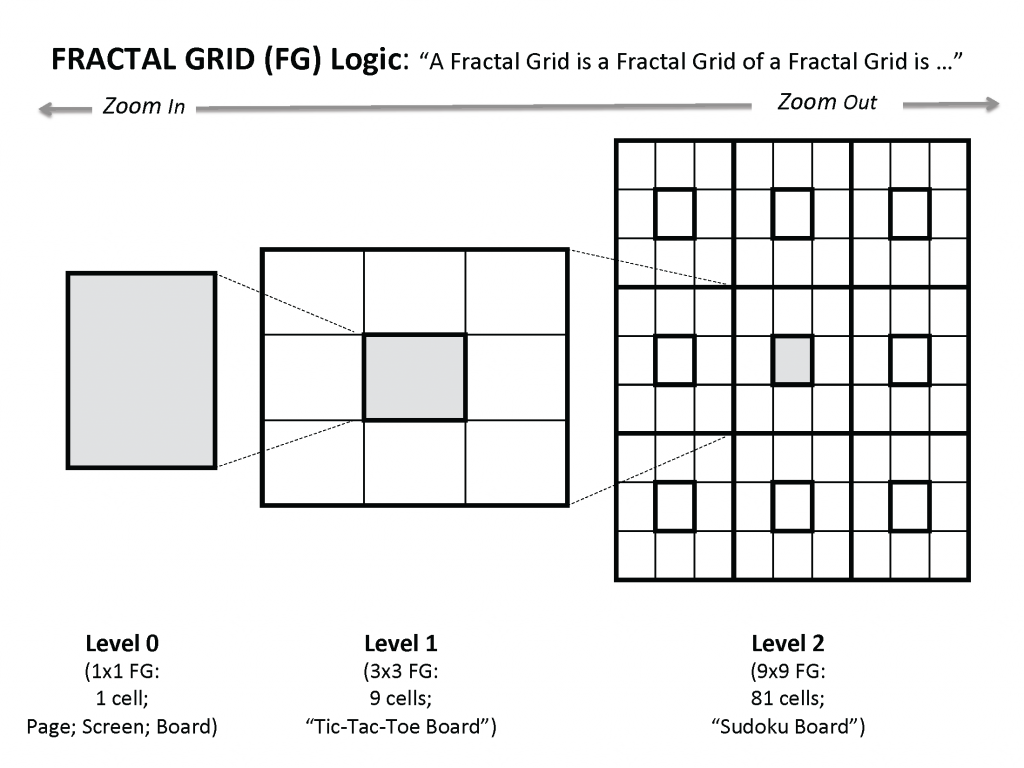
MULTILEVEL FRACTAL GRID (FG):
Level 0 – 1×1 Grid (“Blank Board); Level 1 – 3×3 Grid (FG Tic-Tac-Toe Board); Level 2 – 9X9 (FG Sudoku Board)
WHAT, WHY, WHERE FRACTAL GRID:
A Fractal Grid to Understand POWSAF
POWSAF: Do you see a benefit in teaching FGT to Prince of Wales School students?
Dr. Rod King: I’m glad that you ask this question. My original target market for applying the Fractal Grid Technology (FGT) was the education sector which consists of students, teachers, and educators. As a tool for collaborative and visual notetaking, creativity, problem solving, and task/project management the FGT is second to none. However, when I was seeking venture funding to commercialize the technology, the US investors were interested in using the FGT for a visual search engine platform. We did. And the review from commentators in the media and IT industry was extremely positive.
Our visual search engine startup was being considered as “The Next Google.” But that vision eventually went up in flames as the investors and I had strongly differing strategies about achieving that lofty vision. After that negative experience with the investors/venture capitalists, I decided to pursue my original vision of using the FGT to facilitate Genius Innovation and Polymathism (GIP) especially in the education sector. In contrast to Aristotle, I don’t believe that we are born with a “tabula rasa” or blank slate of knowledge. Rather, I believe that we are born with a box of talents, a box of gifts, a box of Genius Innovation and Polymathism (GIP) that has to be unlocked. I strongly believe that the Fractal Grid Technology has a key that can simply and systematically unlock our GIPs especially at school. I’ve seen and heard many anecdotes of how FGT is helping people around the world to rapidly unlock their GIP box of knowledge.
The most direct evidence, which I have, is of my daughter, Ecy who is studying Human-centered Artificial Intelligence at Stanford University. Here in the US, Ecy has been using the FGT since Kindergarten and I’ve seen the impact on her performance: she had Straight A’s for every year in Elementary School, Middle School, and High School. Her academic performance at Stanford University has been exceptional. Recently, she did a Winter Quarter Abroad program at Oxford University (England) where she had Straight A’s and in particular, A+ in all subjects but one. She daily uses Fractal Gridding for visually recording notes and organizing ideas as well as tutoring Computer Science students at Stanford University and creatively presenting assignments to Professors. Although other arguments could be made regarding factors that drive her academic success, we are strongly convinced that Fractal Gridding has immeasurably impacted her success. And I believe similar level of success could be replicated by any student who is a dedicated and systematic user of the FGT.
Without hesitation, therefore, I’d say that applying the FGT at the POW could positively transform the lives of students, teachers, and parents/guardians. A Fractal Grid looks like a gameboard and using it feels like playing a board game. And that facilitates a state of mind call “Flow.” We could see the unlocking of student Genius Innovation & Polymathism (GIP) never seen at such scale anywhere in the world. It’s a hypothesis that I’ll wait to see disproven. I believe that with teaching FGT at the POW, we could establish a desirable global brand as POW could be the world’s first school that institutionalizes the Fractal Grid, FGT, and Fractal Grid Classroom. Wouldn’t that be a wonderful piece of accolade in future?
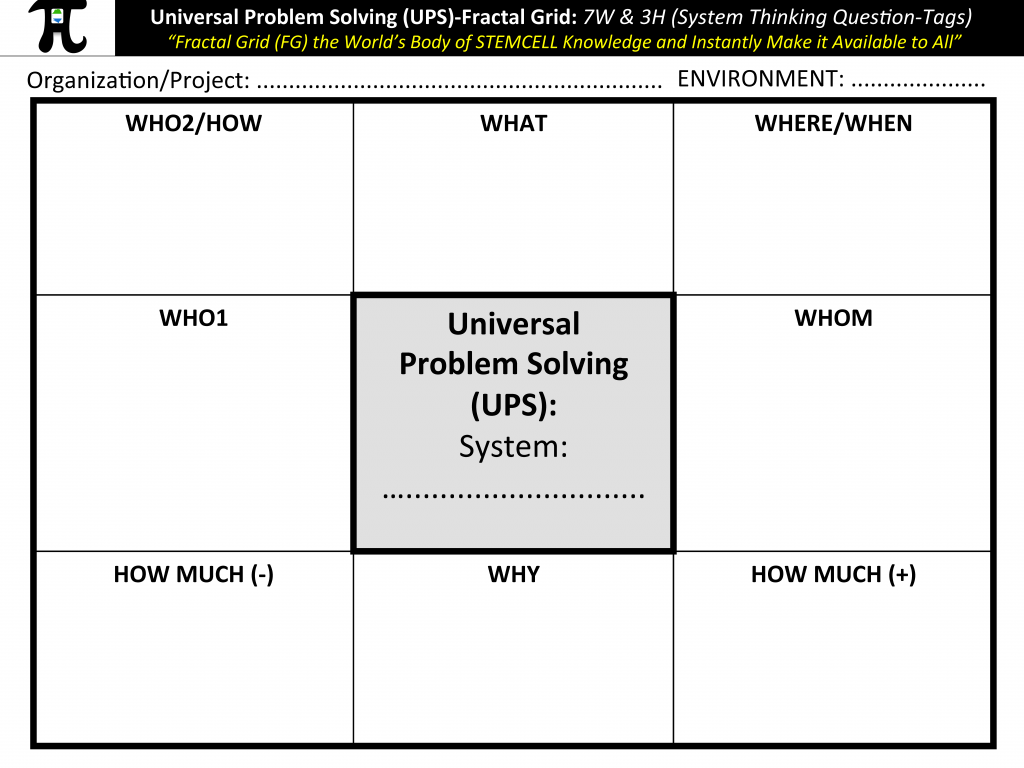
UNIVERSAL PROBLEM SOLVING (UPS)-FRACTAL GRID:
7W & 3H (System Thinking Question-Tags)
POWSAF: How can POWSAF use FGT – for example, to get more Alumni to see the need and benefit of donating to its Endowment investment fund?
Dr. Rod King: First, I’d like to congratulate POWSAF for introducing an innovative mission model to help the POW School system, especially students to achieve their highest potential. As one of the world’s leading experts on Business Model Innovation, I feel that I deeply understand the Mission (Business/Organizational) Model of POWSAF and how it complements the Mission (Business/Organizational) Model of the POW School. Many stakeholders in the ecosystem of the POW School have similar depth of understanding.
However, knowledge about the POWSAF’s Mission Model as well as POW’s Mission Model is tacit; the knowledge is in people’s head. Consequently, there’s no explicitly shared understanding or visual model of how POWSAF works to create, deliver, and share value in its ecosystem. I believe that such lack of knowledge does not inspire alumni to more freely donate because they don’t see the big picture as well as synergies or complementarities in fulfilling the stated mission. They simply do not deeply know how the extent to which they can impact the lives of students and other stakeholders. With use of the FGT, we could rapidly and collaboratively map the Mission Model of POW as well as the Mission Model of POWSAF; each on one page. For POWSAF, the focus should be on strategy argumentation and learning since technically, POWSAF is like a “Lean Startup.”
POSAF still has to develop a repeatable, scalable, and sustainable Mission Model. I believe that the sustainable success of POWSAF would depend on how fast we learn while discovering, validating, and solving its most important problems experienced by stakeholders in its ecosystem. And that is no easy feat. But, a map of the living organism of POWSAF or its Mission Model could help a great deal in rapidly increasing the engagement, acquisition, activation, retention, and loyalty of POW alumni and other stakeholders. This should be a collaborative effort where POWSAF is functioning as a “living, breathing organism,” the survival of which depends on the alignment of stakeholders in its ecosystem. And the FGT can enormously help in this regard especially when the app for the FGT software platform becomes available. POWSAF can use a Fractal Grid to effectively and efficiently organize as well as manage meetings and projects.
Also, an FGT app (visual search engine) could be used to brain-friendly-wise present a group of past and present students in any year or for the whole school while facilitating social networking. Finally, POWSAF can use a Fractal Grid to scalably collect ideas from alumni all over the world about ways of increasing the size of the Endowment Investment Fund. There are many great examples from institutions such as Stanford and Harvard universities that have proven approaches for getting generous donations from their alumni and other stakeholders.
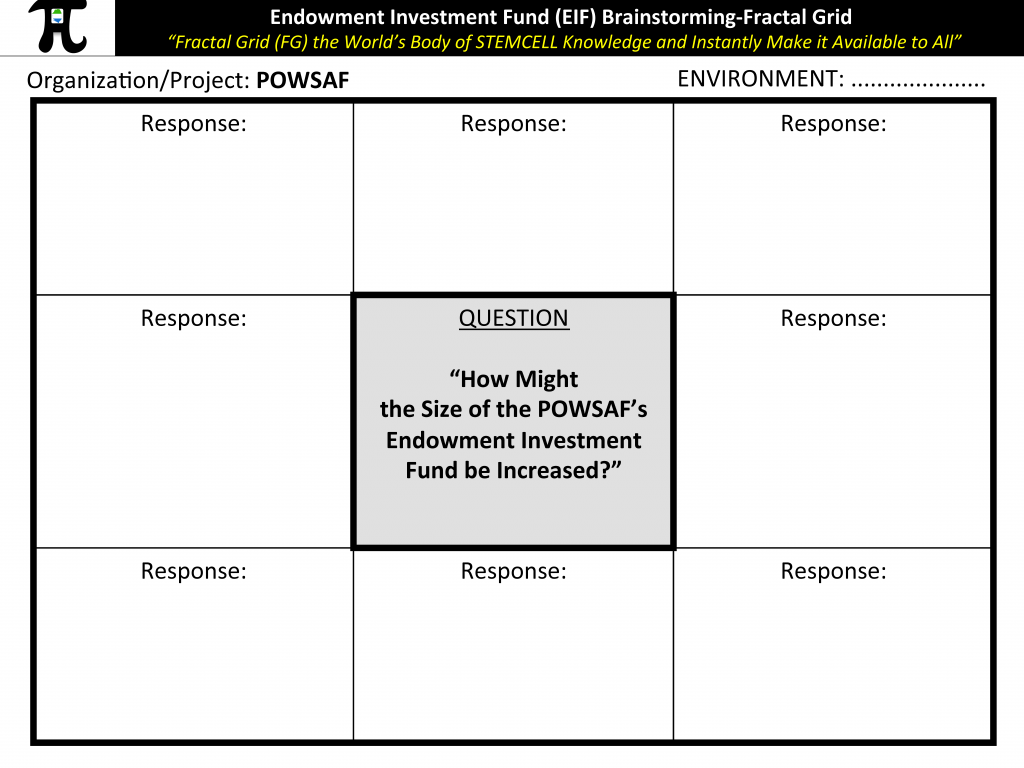
POWSAF BRAINSTORMING-FRACTAL GRID:
“How Might the Size of the POWSAF’s Endowment Investment Fund be Increased?”
Dr. Rod King is an engineer, innovator, inventor, author, and a proud Princewalean. Dr. King believes that personal, team and organizational goals should be F.A.S.T.E.R.: focused, ambitious, space-bound, time-bound, expansible, and reducible in today’s hyper-competitive environment.